Swivel Lifting Points for Multi-Direction Industrial Lifting
RUBY Swivel Lifting Points are designed to provide secure threaded lifting connections for machinery, molds, dies and heavy industrial components. With different swivel and pivot designs available, buyers can select suitable lifting points based on working load limit (WLL), thread size, lifting direction and mounting requirements.
-
![G80 Swivel Hoist Ring Side Loading Lifting Point]() G80 Swivel Hoist Ring Side Loading Lifting PointThe G80 Swivel Hoist Ring Side Loading Lifting Point is a threaded lifting attachment for loads that require angular or lateral lifting. Its 360° rotating body and pivoting load ring allow the sling connection to align with the lifting...view more
-
![G80 Swivel Hoist Ring Eye Bolt]() G80 Swivel Hoist Ring Eye BoltThe G80 Swivel Hoist Ring Eye Bolt is a threaded lifting point for machinery, molds and heavy equipment. Its ball-bearing swivel body rotates 360°, while the bail pivots 180° to follow changing sling directions. Unlike a fixed eye bolt,...view more
-
![G80 Universal Swivel Hoist Ring]() G80 Universal Swivel Hoist RingThe G80 Universal Swivel Hoist Ring is a threaded lifting point for securing slings to machinery, molds and heavy equipment. Its rotating and pivoting bail accommodates changing sling directions, making it suitable for lifting...view more
-
![G80 Lifting Eye Bolt]() G80 Lifting Eye BoltThe G80 Lifting Eye Bolt (RP005) is a fixed threaded lifting point for connecting slings to machinery, molds, fixtures and other equipment. Manufactured as a Grade 80 lifting component, it provides a bolted attachment point for lifting...view more
-
![Grade 80 Key Eye Point]() Grade 80 Key Eye PointThe Grade 80 Key Eye Point (RP004) is a threaded lifting point with a 360° rotating eye and an integrated locking key for installation and removal. Unlike a conventional fixed DIN 580 eye bolt, its rotating eye can align with the...view more
-
![Grade 80 Swivel Rotating Eye Bolt with Ring]() Grade 80 Swivel Rotating Eye Bolt with RingThe Grade 80 Swivel Rotating Eye Bolt with Ring is a threaded lifting point designed to connect lifting slings to machinery, molds and heavy equipment. Its rotating ring and pivoting design accommodate different sling approach angles,...view more
-
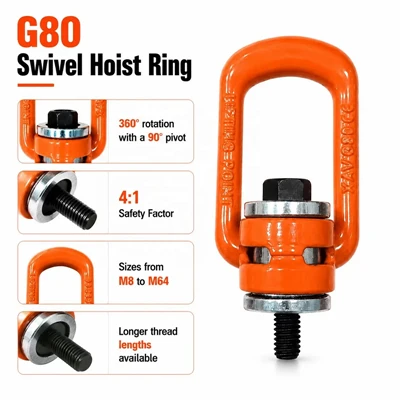
![Grade 80 Swivel Hoist Ring]() Grade 80 Swivel Hoist RingThe Grade 80 Swivel Hoist Ring is a threaded lifting point for securing lifting equipment to machinery, molds and structural components. Its 360° swivel and 90° pivot allow the ring to align with the lifting direction, while the...view more
-
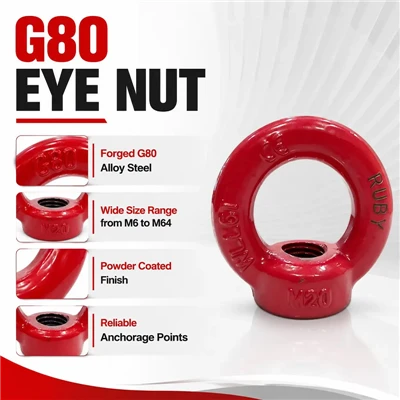
![Grade 80 Lifting Eye Nut]() Grade 80 Lifting Eye NutThe Grade 80 Lifting Eye Nut is an internally threaded lifting component for attaching compatible hooks, ropes or chains to a suitable mounting point. The RP005 series is designed for industrial lifting applications requiring a fixed...view more
-
![Grade 80 Lifting Eye Bolt]() Grade 80 Lifting Eye BoltThe Grade 80 Lifting Eye Bolt is a high-tensile alloy steel lifting attachment for connecting slings, chains or hooks to threaded lifting points. The RP005 series provides model-specific working load limits for vertical and 90° side...view more
-
![Grade 80 Heavy Lift Swivel Hoist Ring]() Grade 80 Heavy Lift Swivel Hoist RingThe Grade 80 Heavy Lift Swivel Hoist Ring is a threaded lifting attachment for connecting slings, chains and hooks to machinery, tooling and other loads. Its 360° rotation and 180° pivot allow the ring to align with changing pull...view more
-
![Grade 80 Heavy Duty Alloy Steel Key Eye Point Lifting Point]() Grade 80 Heavy Duty Alloy Steel Key Eye Point Lifting PointThe Grade 80 Heavy Duty Alloy Steel Key Eye Point Lifting Point is a threaded lifting attachment designed for industrial load handling. Its lifting eye rotates through 360° to align with the pulling direction, helping reduce bending...view more
-
![Anchor Point]() Anchor PointRUBY Anchor Point is a swivel lifting point for machinery and heavy components where the lifting direction can change during handling. The RP004 series combines a forged swivel eye with a bolt and washer assembly, allowing the lifting...view more


Specifications
|
Product Type |
Model / Series |
Working Load Limit (WLL) |
Thread Size |
Movement Type |
|
Swivel Hoist Rings |
[Insert model / series] |
[Insert WLL range] |
[Insert available thread sizes] |
Swivel and pivot |
|
Swivel Eye Bolts |
[Insert model / series] |
[Insert WLL range] |
[Insert available thread sizes] |
According to model design |
|
Swivel Eye Bolts with Ring |
[Insert model / series] |
[Insert WLL range] |
[Insert available thread sizes] |
Rotating ring |
|
Grade 80 Key Eye Points |
[Insert model / series] |
[Insert WLL range] |
[Insert available thread sizes] |
Rotating eye with keyed design |
Swivel Lifting Point Product Range
RUBY offers several swivel lifting point designs for threaded mounting on machinery, molds, dies and industrial components.

Swivel Hoist Rings
Swivel and Pivot Movement: Designed for lifting configurations requiring the bail to change orientation within its rated range.
For Angled Lifting Setups: Consider this design when the lifting direction differs from the mounting axis and the model is rated for that configuration.
Swivel Eye Bolts
Rotating Eye Design: Provides a movable eye connection for compatible threaded lifting points.
For Equipment and Mold Handling: Suitable models can be used where a rotating eye fits the available mounting space and rigging arrangement.
Swivel Eye Bolts with Ring
Rotating Ring Connection: Provides a ring-style sling connection rather than a conventional fixed eye.
For Specific Connection Geometries: Compare the ring opening and available clearance with the intended sling or connector.
Grade 80 Key Eye Points
Integrated Keyed Structure: Combines a rotating eye with a keyed locking arrangement.
For Compatible Threaded Installations: Select according to the model's rated capacity and mounting requirements.

Compare Swivel Lifting Point Designs
|
Design |
Main Difference |
Key Selection Consideration |
|
Swivel Hoist Ring |
Swiveling and pivoting bail |
Permitted lifting direction and pivot range |
|
Swivel Eye Bolt |
Rotating eye design |
Eye geometry and movement capability |
|
Swivel Eye Bolt with Ring |
Ring-style rotating connection |
Ring opening and connector clearance |
|
Grade 80 Key Eye Point |
Rotating eye with keyed structure |
Locking arrangement and model-specific rating |
The most suitable design depends on the required movement, rigging connection and mounting arrangement. Compare the individual model specifications before selecting a replacement or approving a lifting setup.
Applications
Mold and Die Handling
Mold Changes and Maintenance: Swivel lifting points provide threaded lifting connections for compatible molds and dies during installation, removal and servicing.
Restricted Sling Access: A swivel design may help accommodate the available sling approach when the selected model permits the required lifting direction.
CNC Machines and Industrial Equipment
Equipment Installation and Relocation: Suitable models provide designated lifting connections for machinery designed with compatible threaded mounting points.
Limited Overhead Clearance: Compare the lifting point's overall dimensions and movement range with the available space around the equipment.
Fabricated Components and Industrial Tooling
Handling Engineered Components: Swivel lifting points can be incorporated into suitable fixtures, tooling and fabricated parts with engineered mounting locations.
Changing Rigging Directions: A swivel design may suit applications where a fixed eye does not provide the required movement.
Thread and Mounting Compatibility
Correct thread engagement and mounting conditions determine whether a swivel lifting point can be installed and used as intended.
Match the Thread Specification:
Confirm thread type, diameter, pitch and required engagement with the equipment's mounting hole.
Check the Mounting Structure:
The threaded hole and supporting material must be suitable for the intended lifting load.
Allow Movement Clearance:
Ensure the eye or bail can rotate and pivot within its designed range without contacting nearby components.
Verify Replacement Fit:
A replacement must match the mounting interface and permitted loading conditions; the same thread size or WLL alone does not establish interchangeability.

Hardness Testing: A hardness tester checks the finished component against the specified hardness range; results are recorded in the inspection report.
Thread and Dimensional Inspection: Thread gauges verify thread conformity, while measuring tools check critical dimensions against the approved drawing.
Proof Load Testing: The specified test load is applied to applicable models, with the test load and pass/fail result recorded in the report.
Magnetic Particle Inspection (MPI): Applicable components are inspected for relevant surface and near-surface discontinuities, with the inspection result documented.
OEM Customization
Thread and Dimensions:
Available options depend on the product design and manufacturing range.
01
Surface Finish and Color:
Specify the required finish or color for confirmation against the selected model.
02
Marking and Branding:
Product identification, rated-load marking and customer branding can be reviewed for compatible designs.
03
Packaging and Labels:
OEM packaging and order-identification labels can be arranged according to the agreed requirements.
04
Drawing-Based Development:
Non-standard requests can be reviewed using technical drawings, required load rating and order quantity.
05
Supply and Export Support
Flexible Order Quantities:
Sample orders from 1 piece; bulk orders available for distributors and industrial buyers.
Standard Order Lead Time:
Approximately 7–15 working days, depending on model availability and order quantity.
Custom Order Lead Time:
Approximately 15–30 working days after specification confirmation.
Export Packaging:
Products packed in cartons, with pallet packaging available for bulk shipments.
International Shipping:
Sea, air and express shipping options available according to order size and destination.
Export Documentation:
Commercial invoices, packing lists and agreed quality documents can be arranged according to order requirements.
FAQ
As one of the most professional swivel point manufacturers and suppliers in China, our products have good reputation in the market. Please feel free to wholesale durable swivel point made in China here from our factory. Also, custom service is available.